
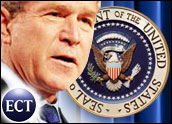
President Bush on Sunday afternoon signed into law a controversial measure giving U.S. government officials increased authority to listen in on international communications without first obtaining a warrant.
S. 1927, also known as the “Protect America Act,” updates the Foreign Intelligence Surveillance Act (FISA) by permitting warrantless surveillance of any targets located abroad, even if they are communicating with someone in the United States.
After a Democratic alternative was defeated 218-207 on Friday night, the bill passed in the Senate 60-28 on Friday, and was approved by the House of Representatives 227-183 on Saturday, just before the start of Congress’s summer recess. The bill will expire in six months unless reviewed again.
‘A Dangerous Gap’
“Today we face a dynamic threat from enemies who understand how to use modern technology against us,” President Bush said after the vote.
“Whether foreign terrorists, hostile nations or other actors, they change their tactics frequently and seek to exploit the very openness and freedoms we hold dear,” he said. “Our tools to deter them must also be dynamic and flexible enough to meet the challenges they pose. This law gives our intelligence professionals this greater flexibility while closing a dangerous gap in our intelligence gathering activities that threatened to weaken our defenses.”
Discussion of the proposed legislation came to a head last week following the revelation of a secret ruling by the Foreign Intelligence Surveillance Court sometime in the last few months in which a request for a generalized warrant to conduct surveillance on a large group of people was apparently denied. President Bush reportedly threatened to keep Congress in session until it sent him a bill he could sign.
‘An Abdication of Our Duties’
The bill was met with widespread expressions of concern and disappointment over its lack of oversight.
“At times of war we don’t give up our responsibility in the U.S. Senate to review and make laws,” said Sen. Russell Feingold, D-Wis. “The notion that we simply defer this to the director of National Intelligence and whatever he says is an abdication of our duties especially in time of war.”
The legislation “means giving free reign to the government to wiretap anyone including U.S. citizens who live overseas, service members such as those in Iraq, journalists reporting from overseas or even members of Congress who are overseas and call home to the U.S., and this is without any court oversight whatever,” Feingold added. “That is unacceptable. It goes far, far beyond the identified problem of foreign to foreign communications that we all agree on. And it goes far, far beyond the public descriptions of the president’s warrantless wiretapping program.”
‘Unacceptable’ Provisions
Speaker Nancy Pelosi, meanwhile, immediately fired off a letter to Judiciary Committee Chairman John Conyers Jr. and Permanent Select Committee on Intelligence Chairman Silvestre Reyes, requesting that the committees report to the House as soon as possible after the Congressional break.
“Many provisions of this legislation are unacceptable, and although the bill has a six month sunset clause, I do not believe the American people will want to wait that long before corrective action is taken,” Pelosi wrote.
“Accordingly, I request that your committees send to the House, as soon as possible after Congress reconvenes, legislation which responds comprehensively to the Administration’s proposal while addressing the many deficiencies in S. 1927,” she added.
Privacy advocates expressed similar concern.
Opening the Door to Abuse
“I think the critical problem with these amendments to FISA is that they remove necessary oversight, and open the door to the abuse of the privacy rights of American citizens,” Marc Rotenberg, executive director for the Electronic Privacy Information Center (EPIC), told the E-Commerce Times. “But I’m hopeful that Congress, when it gets back from its recess, will look at all of this more closely,” he added.
“We’re deeply disappointed by this series of votes,” David McGuire, a spokesperson for the Center for Democracy and Technology, told the E-Commerce Times. “We think that an alternative was presented that would have given law enforcement what it needed to conduct this important and worthwhile foreign-to-foreign surveillance while also protecting the rights of innocent Americans.”
The new legislation, he added, is “a grossly overbroad bill that opens the door to unchecked surveillance on innocent Americans in the United States.”





















 Loading ...






















Social Media
See all Social Media