
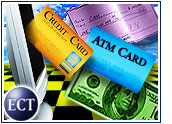
I have seen the studies. I know that fraud is moreprevalent online and that many people are wary ofgiving their credit card information to Internetmerchants. But credit cards still seem like the bestand most convenient option.
I’m sure I would besinging a different tune if mine had been one of thecredit card numbers snatched by hackers, but I justdon’t see a real need for alternate payment systems.
8 Million Users
Such systems seem to have caught on with auctionsites: PayPal has alucrative deal with EBay (Nasdaq: EBAY) andclaims to have more than 8 million registered users.Nothing against PayPal, but I would be curious to knowhow many users registered, used the service once and then gave up.
The company claims its system is more convenient than credit cards,but I don’t think any payment system is easier thantyping in a credit card number, which I can do in threeseconds flat, from memory, with one hand tied behindmy back.
Pay To Play
With online payment systems — such as PayPal, Citibank’sc2it and Ecount — you must not onlyregister and open an account, but also pay a fee for some types of transactions.
Use a creditcard and let the merchant pay the fee, that’s my motto.
And most online payment services let online shopperspay with a check, bank transfer or credit card. Whynot just use a credit card in the first place?
Online payment systems have real value forsmaller Web merchants because they cost less thancredit cards — but unless consumers are offered moresignificant incentives to use them, these systems are unlikely to catch on for non-auction e-commerce.
Fraud Still Exists
Then there is the safety issue. Online payment systemshave not been immune from fraud, especially in theearly days of e-commerce.
And for those concerned about giving out acredit card number online, does it really make moresense to give a payment system direct access to yourchecking account, as you must with Western Union’s MoneyZap?
When problems with online fraud have cropped up in the past, customer service has been less than stellar.And because person-to-person payment systems are notregulated by brick-and-mortar banking laws, consumershave nowhere to turn if they have a problem with such a system, be it fraud or some other complaint.
Cash and Web Don’t Mix
Proponents of online payment systems argue that asignificant percentage of the population uses cash orchecks exclusively. Therefore, they say, Web sites that cannot accept those forms of payment are missing out on a hugemarket.
But are those people really likely to use theInternet to make purchases? My father doesn’t believein credit and uses his checkbook so often he shouldhave a holster for it, but you couldn’t get him nearthe Internet if you hitched him to a team ofClydesdales.
No Big Deal
It’s not that I don’t know what it’s like to havea credit card stolen. In fact, I have had plentyof experience — just not online. Once, a crafty NewYork subway criminal relieved me of my wallet and wenton a buying spree at Woolworth. Nothing like shootingfor the stars.
Another time, I left my credit card in my hotel room,and someone on the housekeeping staff found it andhelped herself. It was just like Internet fraud — Inever even knew the card had been used until I got thebill. Fortunately, the thief was dumb enough to order amultitude of goods on the Home Shopping Network andhave them delivered to her home address.
Presumably, Internet criminals are a bit more savvy,since they need to know how to hackinto a Web site. Even if your credit card isstolen, however, all you have to do is call thecompany in order to be absolved of almost all charges.
I realize, of course, that I have now jinxed my luck,and I fully expect my credit card number to be stolenthe very next time I buy something online, after whichI will be right back here complaining about theshameful lack of Web security. Stay tuned!
What do you think? Let’s talk about it.
Note: The opinions expressed by our columnists are their own and do not necessarily reflect the views of the E-Commerce Times or its management.

















 Loading ...






















The benefit I perceive in using an electronic transfer service such as PayPal is that you are only providing your credit card or banking information to one business instead of every business that you purchase from. The ETS then remits payment on your behalf and the supplier does not receive your financial info. If you trust the ETS’s security measures and use such a service you are not at the mercy of each individual member’s security systems or potential lapses.
Obviously this only works with merchants who are using PayPal. PayPal is claiming 12,000,000 registered users in 37 countries, including 2.2 million businesses and growth of 18,000 new accounts per day. (I’ve been researching the topic for an ecomm class.)
Is this type of service the wave of the future or will biometric scanners and the like be the rage?
Yes, credit cards are the best way to pay today.
The Visa Verified Pin based program is a simple solution that should help to eliminate fraud.
By the end of the decade, however, there will be a convergence of several security systems all tied to authentication of the user. MSN Passport, The Liberty Alliance, Paypal, Ecount and C2it all offer good services. The final picture for secure payments will be a convergence of most of the above, and will still be centered upon a credit/debit card number. A Purchase/Payment account may be set up though to avoid exorbitant loss due to fraud. It’s better to have an insured/secured account with just a few hundred to a few thousand set aside, rather than a $5-$100,000 credit line or checking account attached to the card number.
By the end of this year or next, PCs will be sold with a Chip/Mag Stripe Card Reader. The card readers are much like the ones used in retail stores. Users will be authenticated via smart chip and PIN.
So, in the future, giving away your credit card to every site will be a thing of the past. Online Wallet/Payment Security companies will partner with retailers whereas consumers will register their card with the service provider at time of purchase and thus will be registered for purchasing without sharing card info at all the other sites. Payment Processing companies will partner with the Security Service providers to offer retailers a combination of shopping cart/rewards/payment processing/online wallet service.
Want to know more? Email me.
Randy Smith