
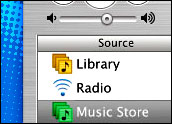
Last week, Apple’s iTunes Music Store sold five times as many songs as the newly relaunched Napster service. According to Nielsen SoundScan, which measures digital download numbers, iTunes accounted for about 80 percent of all legally downloaded music files during the week. And at an analyst meeting Wednesday night, Apple CEO Steve Jobs commented that his company is now “the Microsoft of music stores.”
While that may be hyperbole at this point — Apple has admitted it does not make a penny from 99-cent music downloads, making iTunes a far cry from Microsoft’s Windows cash cow — it is not a throwaway statement. Although longtime Apple-lovers may not be happy to compare their beloved company with its onetime archnemesis, Jobs’ quip may be a truer indication of Apple’s future direction than it seems at first glance.
Let’s stop thinking about Apple as a niche seller of sleekly designed computers for a moment. Let’s abandon that tired premise and take a step into the world of what could be.
Can’t-Win Situation
What if Jobs is more serious than his seemingly flippant comment indicates? Apple’s story is pretty much played out in the personal computing arena, give or take a few percentage points. Sure, the company may gain market share as a result of its vastly improved OS X operating system or its increasingly price-competitive iMacs, iBooks and PowerBooks. Even its G5 Power Macs, once the exclusive domain of graphics professionals and die-hard power users, have entered the realm of the somewhat affordable.
But Apple will never overcome Microsoft’s vast lead on the desktop. The Redmond titan has established a stranglehold that is self-perpetuating. Everyone else is using Microsoft, so the easiest — and cheapest — choice for most average consumers and enterprises is to stick with the de facto industry standard. Although gripes and groans about Windows security or bugs are commonplace, most people are not dissatisfied enough to actively seek something better and embark upon the resulting learning curve. Unless Microsoft unexpectedly implodes — hard to imagine, considering its multibillion-dollar cash reserve — no competitor is likely to make significant inroads against its desktop stronghold.
In addition, Apple has failed to make significant progress in the enterprise arena with its Xserve. Many enterprises simply are unwilling to take the leap of faith required to install Apple machines on turf traditionally ruled by Unix and Windows servers (though those that have done so generally have reported good results).
Beyond Boxes
Apple likely could carry on indefinitely as a profitable company in its established niche. But under Steve Jobs’ leadership, the company has never been content simply to drift along. It dreams big, it dreams out of the box — and now it may be dreaming itself into the pole position of an entirely new marketplace.
Think about it: If Apple cannot achieve dominance in the desktop computing sector, wouldn’t it make more sense for the company to focus on a wide-open emerging market, such as online music? The stage is set for digital music sales to take off. The Recording Industry Association of America is suing users of free peer-to-peer file-trading applications, such as Kazaa. As a result, according to published reports, traffic on free networks is down significantly, and many users are even deleting their existing collections of pirated music files.
Meanwhile, legitimate digital music stores are proliferating and prospering. Previously onerous digital rights management (DRM) restrictions have been relaxed, allowing users to burn copies of downloaded songs to CDs or possess multiple copies of a downloaded music file. Apple, which launched its iTunes Music Store last April, says it has sold more than 17 million songs online so far, and millions more have been sold by competing services, such as MusicMatch and the now-defunct Pressplay (replaced by Napster). According to recent published reports, MTV and Wal-Mart also are planning to leap into the online music melee.
Despite fierce competition, Apple’s head-start has given the company a tremendous advantage out of the gate. It commands a lopsided share of the online download market so far, as SoundScan’s 80 percent figure shows. If it can maintain that sort of dominance, it seems conceivable that iTunes could become the de facto standard, relegating other online music stores to the sidelines. In fact, thanks to some potentially genius standards maneuvers, Apple could establish its own self-perpetuating dominance, making Jobs’ “Microsoft of music” comment more than a passing brag.
AAC or Bust
It works like this: Unlike most of its competitors in the online music space, Apple has chosen the Advanced Audio Coding (AAC) compression format for iTunes music files. Apple’s iPod is the primary player of AAC files, so most iTunes users, by default, probably will purchase iPods. IPods, in turn, do not support the Windows Media Audio (WMA) compression format used by many of iTunes’ competitors, including MusicMatch and Napster. (IPods do support the widespread MP3 standard, although some people claim such files are of lower quality than WMA or AAC files.)
So, if an iPod user wants to buy music online, the obvious choice is iTunes. The iPod is currently the top-selling digital music device. See where this is leading? Of course, if Apple fails to establish dominance, its reliance on AAC could backfire, killing sales of iPods as sales of WMA-compatible devices skyrocket.
Moreover, if Apple succeeds in achieving online music dominance, it will have tremendous influence — not just over its competitors in the online music space, but over the entire music industry. The shift from CD sales to online music sales is not likely to slow down, let alone reverse. It is likely that within the next several years, music downloads will replace CD sales as the primary method of music distribution.
The company that owns this marketplace will own the industry, wielding tremendous leverage over the major labels that rely on this channel for an increasing proportion of their revenue. As just one example, what would happen if Apple threatened to bypass the major labels entirely and deal directly with artists if the labels refused to toe the line?
Swimming with Sharks
Wait a minute, you might say. Does Apple really want to dominate the recording industry? Don’t forget the rumors that cropped up last spring, saying Apple might be interested in purchasing a stake in Universal Music. That did not come to pass, but it did offer a tantalizing glimpse of Apple’s shift toward the entertainment sector and away from traditional computing. The company’s wholehearted leap into the online music sector shows that Apple is no longer content to play in its well-defined desktop pond; it wants to swim with the sharks in a new and potentially vast ocean. This seems somehow fitting: The company has never been content to stay still. It is innovating constantly, driving change, thinking ahead.
Let’s think ahead ourselves. What would Apple do with leverage over the recording industry? Theoretically, the answer is that Apple could do almost anything. It could pressure major labels to withdraw their support for competing services. If it wanted to be less obvious, it might encourage labels to explore ways to optimize songs for the AAC format. It might even be able to influence the type of songs being produced in the industry at large, based on what iTunes users are downloading.
Why stop there? Let’s take this line of thought even further. If Apple were to gain control of the online music distribution channel, why wouldn’t it take the next step and create a full-fledged entertainment conglomerate? Steve Jobs is not just the CEO of Apple; he is also the CEO of Pixar, which has produced smash-hit animated features Toy Story, Toy Story 2 and Monsters Inc.
A merger or acquisition involving Jobs’ two offspring could create a nearly unstoppable force in the entertainment industry. With such a strong foundation, there is no telling what Apple could do — but there is an excellent chance that it could be bigger than anything the company accomplished in the computer industry.
Stephanie Losi is managing editor of the E-Commerce Times.










 Loading ...






















Let’s not forget that AAC is the audio component of the MPEG 4 video standard. It would have been better to call the music files mp4 rather than AAC, but this extension is already being used for MPEG 4 in general. AAC is not a proprietary Apple format like many people seem to believe and is as close to an open standaed as mp3 is. Having said that I believe the DRM is a proprietary Apple solution and, last I looked, open source DRM is still being developed.
Thanks
It seems that the author of this article did not do research well before writing the fact about AAC. iTune is not the only player that support AAC in the market. Philips, Panasonic, Compaq, and GoVideo also support this format as well.
According to the first paragraph under the topic of "AAC or Bust", it is not just "some people" that claim the quality of AAC is superior than MP3. In fact, it is definitely better than MP3 in every angle. According to the result of AAC subjective tests at MPEG site, it says "Section 10.6 presents the answer to this. Overall, all AAC profiles at 128 kbps give significantly better performance than do MPEG-1 Layer II at 192 kbps or Layer III at 128 kbps. Therefore the goal of high audio quality at 64 kbps per channel for MPEG-2 AAC has been achieved. Both AAC Main Profile and Low Complexity Profile provide quality at 96 kbps that is comparable to MPEG-1 Layer II at 192 kbps, and therefore give a 2 to 1 compression advantage. In addition, AAC Main Profile at 96 kbps gives better results than MPEG-1 Layer III at 128 kbps." Furthermore, the blind tests have already been conducted and demonstrated that AAC is superior than MP3. You can find the result at http://audio.ciara.us/test and http://ff123.net.
In my opinion, it is not the problem of Apple to advertise how good AAC is. However, it is the issue that when the industries will manufacture hardware that support AAC, or when AAC has become popular AM ong users. Many audiophiles have recognised this format long time ago. More than 50% of those who recognises more than one audio lossy format, which is MP3, they prefer other formats including AC3, AAC, OGG, and MPC. If there is just one brand starting to produce hardware that support, those users will eventually buy the hardware.