

The customer data platform (CDP) industry is entering a new phase as standalone CDPs give way to broader enterprise marketing suites.
New platform enhancements from SAS, an analytics and AI software firm, reflect the growing integration of customer data management with enterprise marketing platforms.
CDPs serve as the central data engine for commerce and CRM, cleaning and stitching together data from website activity, mobile apps, emails, and point-of-sale systems — including anonymous browsing behavior, online orders, and offline store visits — to create a unified, 360-degree profile of each customer.
Demand for unified customer data continues to grow, but organizations increasingly expect those functions to be built into broader cloud ecosystems and native martech suites.
The Gartner 2025 Magic Quadrant for Customer Data Platforms predicts that by 2028, the data management market will converge into a single data ecosystem enabled by data fabric and GenAI.
Lisa Loftis, principal management consultant of customer intelligence at SAS, sees the company's embedded, composable CDP within Customer Intelligence 360 as an approach with long-term staying power. Instead of traditional CDPs that require organizations to copy customer data into one system, SAS lets marketers activate data directly from their cloud data stores.
"At least for those CDP vendors whose eyes have always been on the ultimate prize — native architecture from the ground up across all customer engagement capabilities, it provides true composability in both data and features and real-time decisioning that is truly real-time," she told the E-Commerce Times.
She sees growing agreement among marketing technology analysts that CDPs will become standard components of large enterprise marketing solution suites, such as customer engagement platforms or real-time interaction engines.
Standalone CDPs Are Giving Way to Enterprise Suites
Loftis believes standalone CDPs are disappearing as composable architectures become the preferred approach, with CDP functionality becoming an embedded feature within broader enterprise suites. She expects independent vendors to face increasing pressure unless they are acquired or broaden their capabilities.
"As more companies buy into the cloud data warehouses and place more emphasis on comprehensive capabilities around journey orchestration, AI-driven insights, and real-time decisioning, CDPs with limited capabilities will continue to lose their luster," she said.
Loftis noted that Gartner's latest CDP analysis indicates the industry is moving toward two broad approaches: enterprise customer engagement platforms and AI-driven capabilities layered on top of cloud data warehouses.
She added that Gartner expects customer data decisions to increasingly involve marketing, sales, finance, supply chain, and customer service, reflecting the expanding enterprise role of customer data.
Composable Data Comes With Hidden Pain Points
Loftis said composability is typically about both data strategy and capability modularity, which can introduce significant issues on both sides. One issue is that CDP activation is only as effective as the quality of the underlying cloud data warehouse. Organizations still must ensure the underlying data is clean.
"This is not a given, and it is not something typically addressed by vendors selling zero-copy CDP tools, thus becoming an issue discovered after the CDP is purchased. And addressing these issues comes at a cost that is also not factored into the price of the CDP itself," she explained.
Compute costs can be another significant factor. Cloud data warehouse vendors charge based on compute usage. When typical CDP activities — identity resolution, audience building, analytics — occur directly in a cloud data warehouse, the organization incurs additional compute costs.
"CDP-related workloads can significantly increase cloud data warehouse usage because of the frequency and breadth of the queries required to maintain quality," Loftis added.
Loftis also cited personally identifiable information (PII) as a concern tied more to the modular architecture of composable CDPs than to data strategy itself. While most customer data remains in the cloud data warehouse, PII still must move to the tools and channels that handle journey orchestration, decisioning, and activation. In a more robust CDP with those capabilities built in natively, that becomes less of an issue.
"However, if each capability is carried out in a different toolset or application, the PII can be duplicated widely," she warned.
Automated Decisioning Needs Better Guardrails
Loftis agreed that the growing use of automated decision-making engines that act on real-time customer data requires brands to establish new guardrails. These should include explainability and transparency so marketers can understand decision logic, AI model behavior, and outcomes.
GenAI should provide this information in clear, concise language that marketers can understand without needing a data science background. It should also analyze the decisions, make recommendations for changes based on decision performance and model health, and account for considerations such as contact policies and arbitration between competing offers, she suggested.
"Models in the decision intelligence arena should also include automatic bias mitigation and be retrained as necessary, ensuring trustworthy and responsible AI-powered decisions," she said.
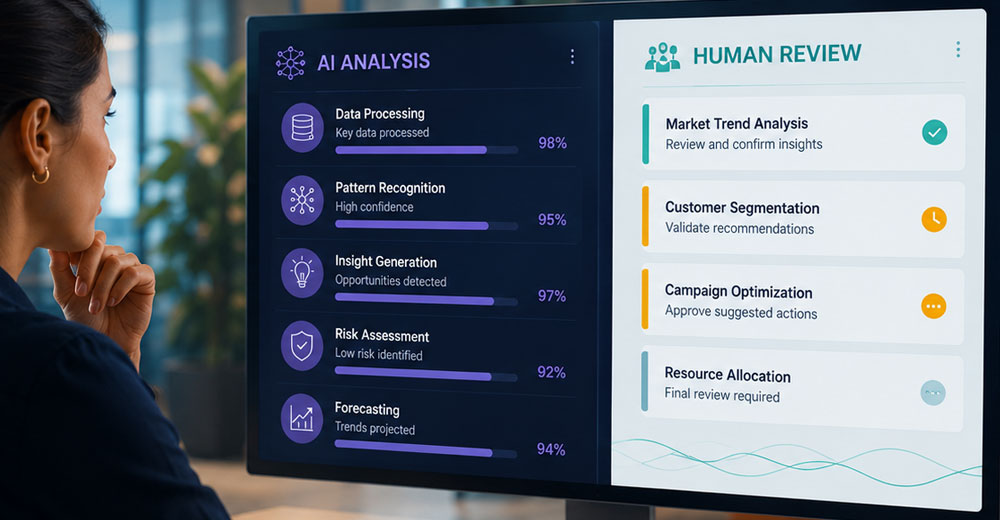
Loftis added that her recommendations are all part of human-in-the-loop initiatives. If agents are used to make decisions, a human should have ultimate responsibility for approving the final decision before it is deployed.
"There should also be a two-way data flow from the decision execution back to the decision intelligence environment for decision results so that performance can be analyzed and decisions and models refined continuously," she added.
Has the CDP Outgrown Its Category?
The emphasis is no longer on unifying customer data but on activating it natively within broader enterprise platforms. Loftis noted that CDPs were originally designed to help marketers unify, segment, and activate customer data. The goal was to solve the challenge of integrating customer data from disconnected systems.
"The category has evolved to focus as much on what marketers do with the data as on getting it integrated and unified," she reasoned.
She pointed to comments by David Raab, founder and CEO of the Customer Data Platform Institute, who argued last year that the CDP category is evolving rather than disappearing.
“There’s nothing radical about a CDP being embedded in a customer-facing system. In fact, statistics in our Industry Update report have long shown that what we call 'campaign' and ‘delivery' CDPs comprise more than two-thirds of the industry. The truth is, the market long ago decided it preferred a CDP that was part of a larger product. So the latest round of acquisitions reflects a continuation of that situation, not a radical departure,” she said.



















 Loading ...

























Social Media
See all Social Media