
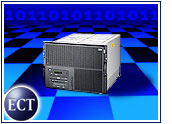
In a bid to capture more of the mid-range server market, IBM has introduced aneight-way Unix machine. Dubbed the eServer pSeries 650, the new unitincludes some features that were previously available only in higher-end units.
The p650 server also represents a price decrease from the p660, which itreplaces. Like the p660, the new offering can handle the many server chores required of mid-size enterprises, including supply administration, CRM tasks and database management.
A Faster Chip
IBM was able to reduce the price of the p650 partially because the new server uses the company’s Power4+ chip, an enhanced version of its Power4 line.
Chips in IBM’s Power4 family are built with two processing cores, giving them adistinct advantage over many of today’s single-core chips and enabling IBM tobuild an eight-way server simply by adding four chips to the unit — asignificant savings for the manufacturer. IBM launched the processor line late last year, originally using it in its higher-end Regatta servers.
The Power4+ is fabricated on the .13 micron manufacturing process, which IBM claims makes it more energy efficient and faster than previous Power4 chips.
The chip in the p650 is available at a speed of either 1.2 GHz or 1.45 GHz.
Big Blue’s Autonomy
IBM’s autonomic computing features, which allow effective server maintenancewith fewer personnel, have proven attractive to buyers in the high-end servermarket.
With the p650, some of those features are migrating to the mid-range. For example, the p650 will include IBM’s Dynamic Processor De-Allocation,which helps guard against system failure.
“We’re now expanding ourautonomic capability across our entire product portfolio,” IBM spokesperson Michael Loughran told the E-Commerce Times.
Profit Margins
Although servers powered by Intel chips hold a larger share of the server market, Unix boxes tend to offer their manufacturershigher profit margins. Businesses typically spend more than six figures on Unix servers.
In contrast, the base version of the p650 retails for US$30,000 — a distinctly mid-rangeprice — though if all potential options are added its price can rise to $130,000.
Tight Race
In the high-end sector, IBM’s Regatta servers have captured more than 50 percent of the market, according to research firm IDC. But in the mid-rangemarket, IBM lags behind Sun and HP.
Since the late 1990s, the three companies have continuously jockeyed forposition. IBM has used its ability to include business services or additional PCs to make its server deals more attractive.
Yet analysts claim Sun remains the market leader in theeight-way server market.
With the release of the p650, IBM is offering a server in a very similarprice range to that of comparable Sun models. But according to IBM, its new server runs faster than similar Sun units because of its Power4+ chip.
Because it fabricates its own chips, IBM contends that it will be ableto sell a variety of server configurations at attractive prices.


 Loading ...






















Social Media
See all Social Media