

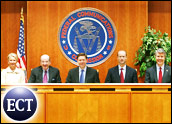
Comcast has answered the Federal Communications Commission’s order — to not only cease its controversial network management practices, but also reveal them publicly — with a legal maneuver of its own: The cable provider has asked the Court of Appeals for the DC Circuit to overturn the ruling.
Prior to this juncture, Comcast has been circumspect in its dealing with the FCC on this matter, unwilling to challenge its authority outright. Now, though, the battle lines have been drawn.
Comcast is arguing that the Communications Act does not explicitly give the FCC the power to issue the ruling.
“We filed this appeal in order to protect our legal rights and to challenge the basis on which the FCC found that Comcast violated federal policy in the absence of pre-existing legally enforceable standards or rules,” said Comcast Executive Vice President David L. Cohen. “We continue to recognize that the Commission has jurisdiction over Internet service providers and may regulate them in appropriate circumstances. However, we are compelled to appeal because we strongly believe that, in this particular case, the Commission’s action was legally inappropriate and its findings were not justified by the record.”
For its part, the FCC remains adamant that Comcast make its policies more transparent.
“Given Comcast’s past failure to disclose its network management practices to its customers, it is important Comcast respond to the many still-unanswered questions about its new management techniques,” said FCC Chairman Kevin J. Martin. “In particular, what exactly does it mean by a ‘protocol agnostic’ management technique? Will there be bandwidth limits and, if so, what will they be? Will they be hourly? Monthly? How will consumers know if they are close to a limit? If a consumer exceeds a limit, is his traffic slowed? Is it terminated? Is his service turned off?”
Invasive and Anticompetitive
The FCC’s ruling, announced last month, found that Comcast’s network management practices were invasive and likely motivated by anticompetitive issues.
“Comcast monitors its customers’ connections using deep packet inspection and then determines how it will route some connections based not on their destinations but on their contents,” said the FCC.
The cable provider would have to make a full disclosure of its preferential routing practices to the FCC, the agency ruled, in addition to ceasing those activities. The government gave Comcast until the end of the year to stop the practices and ordered it to spell out how it will manage its networks after that deadline.
Comcast had a few options once the FCC made its ruling. It could have appealed to the courts to request a stay, or it could have filed a petition for reconsideration by the FCC. It could also have complied with the ruling — something that Comcast said it will do until its appeal is heard.
Of all these choices available to the company, filing an appeal was the most palatable, Jonathan L. Kramer, founding attorney of Kramer Telecom Law Firm, told the E-Commerce Times.
Comcast is facing several suits on this issue, and the disclosure requirement would have provided a road map for the litigants, he said.
Now, by filing an appeal, “whatever information it submits regarding past practices will probably be under some protective order until and unless the Court reverses the FCC’s decision,” said Kramer.
Dubious Argument
Advocates of Net neutrality, not surprisingly, take issue with Comcast’s appeal.
“What Comcast is saying, in essence, is that the Commission may have oversight on these matters — but it doesn’t have the specific authority to make this ruling,” said Ben Scott, policy director with Free Press, one of the advocacy groups that filed the original complaint against Comcast.
“What it is trying to do is separate jurisdiction from authority,” he told the E-Commerce Times.
Parsing the Communications Act
In a 65-page supplement that it released after its initial ruling, the FCC pointed out eight different clauses in the Communications Act that gives it the power to act, Scott noted.
It cites the 2005 Supreme Court decision in FCC v. Brand X, in which the court specifically stated that “the Commission has jurisdiction to impose additional regulatory obligations [on information service providers] under its Title I ancillary jurisdiction to regulate interstate and foreign communications,” and that “the Commission remains free to impose special regulatory duties on facilities-based ISPs under its Title I ancillary jurisdiction.”
Comcast has argued that the Commission cannot exercise jurisdiction over its interference with peer-to-peer TCP connections, because such authority must be “ancillary” to something, the FCC noted, adding “but here it is not clear what that something might be. As Comcast recognizes (albeit implicitly), the [Communications] Act gives the Commission ‘broad authority’ under its ancillary authority to regulate interstate and foreign communications ‘even where the Act does not apply.'”
As muddy as the legal waters may seem to Comcast, the FCC wrote, “we think our ancillary authority to enforce federal policy is quite clear. Peer-to-peer TCP connections provided through Comcast’s broadband Internet access service are undoubtedly a form of ‘communication by wire,’ so the subjectmatter at issue here clearly falls within the Commission’s general jurisdictional grant under Title I.”
Fast Track to Net Neutrality?
Ultimately, the FCC ruling — and, perhaps, an appeal all the way to the Supreme Court — could decide the Net neutrality debate more efficiently than any legislation introduced in Congress. If the high court should decide that the FCC does not have the authority to issue the order, ISPs will be free to manage their networks however they please.
If the court supports FCC, it is game over for Comcast.
“We just have to wait and see how far the court believes the FCC’s authority goes,” Kramer said.










 Loading ...





















Social Media
See all Social Media