
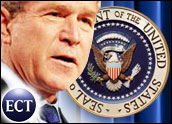
President George Bush has signed into law a measure that overhauls wiretapping rules and grants immunity to telecom companies that cooperated with a secret warrantless wiretap program. The administration established the spying operation after Sept. 11 to gain greater flexibility in eavesdropping on suspected terrorists’ conversations.
The bill addresses a broad range of surveillance activities, limiting what the government can do in certain circumstances, but giving it more wiggle room in others — including espionage activities against U.S. citizens.
However, the most controversial aspect of the bill, by far, is the immunity it provides for telcos.
Since the program was outed two years ago by a former telco employee, critics have argued that there were processes in place that allowed ample flexibility, and that the Bush administration was making an end run around the Fourth Amendment.
Furthermore, there were incidents of eavesdropping on people with no known terrorists ties, according to at least one lawsuit against the telecos. It has been impossible to determine whether those claims are true, because the Bush administration has not been forthcoming with details about the wiretapping program.
Sticking Point
That stonewalling has been a sticking point in negotiations between Congress and Bush, but the president has been immovable, insisting that the absence of a telco immunity provision would be a deal breaker for any legislation that might come across his desk.
Bush and his advocates argued vehemently that the bill was necessary to monitor terrorist plots. Without immunity, they argued, telecom companies would be unwilling to participate in similar programs going forward.
Critics of the legislation — a group that ranges from privacy advocates to Constitutional purists — said that granting such immunity would amount to giving the telecoms and the government a blank check.
Objections Raised
“The fact that we are immunizing these companies without knowing what happened could make it difficult to challenge the legality of a wiretap in the future,” Ross Buntrock, an attorney with Womble Carlyle, told the E-Commerce Times. Buntrock represents competitive telecom providers: providers of VoIP services, Internet service providers, competitive local exchange carriers — basically, any company that is not an incumbent carrier.
If such a company had opened up its switch to law enforcement without a subpoena, he observed, “it would have faced severe consequences.”
It is also questionable that known terrorists were the only ones caught in this particular net, Laurence Pulgram, an attorney with Fenwick & West, told the E-Commerce Times.
Pulgram, along with the American Civil Liberties Union and the Electronic Frontier Foundation, represents a group of people who claim their call records were turned over to the National Security Agency by AT&T and Verizon without the production of a warrant. The group includes doctors, defense attorneys and clergy — that is, people whose call data is often very sensitive.
Unless a legal challenge overturns it, the new law will effectively end their case, Pulgram said. It will allow the attorney general to certify that the telco was acting under the written authority of the Bush administration, and — presto! — it will be liability free.
The law’s encroachment on judicial review — that is, Congress granting the attorney general power to decide what happens to a particular case — may open the door to a court challenge. “Judges are supposed to decide cases, not the attorney general,” remarked Pulgram.
Looking Ahead
The Fourth Amendment may also provide grounds for a challenge. “Even if Congress can rewrite the FISA regulations, it cannot rewrite the Constitution to immunize against violations of the Fourth Amendment,” he added.
Although there will surely be legal wrangling ahead, Pulgram said the new law will make his job as plaintiff’s attorney in the telco lawsuit much harder.
Still, there is a high likelihood it will be challenged on Constitutional grounds, Peter Vogel, an attorney with Gardere Wynne Sewell, told the E-Commerce Times. “The question of whether this represents an unlawful seizure of personal data is a real one.”











 Loading ...





















the judge who issued that particular order for
communist puppet george bush needs to be removed
from the bench, arrested, prosecuted, and sent to
prison for life. and while that judge is in
prison he/she should be made to write: "S&L" on
the prison walls every day of said term. but the
stupid people who allowed the communist scumbag
to be PUT in office by the communist-controlled
TV industry should be the ones— under the U.S.
Const.— executing communist puppet Bush (both
of them in fact).