
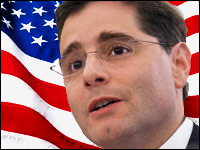
The Internet first acquired its designation as “information superhighway” via the Clinton administration in the 1990s. It added an express lane with the rise of wireless broadband in the early 21st century, and FCC chairman Julius Genachowski completed the automotive metaphor Wednesday with a speech that warned of a looming spectrum traffic jam if wireless growth isn’t managed properly.
“We are fast entering a world where mass-market mobile devices consume thousands of megabytes each month,” Genachowski said at the annual CTIA wireless industry trade show in San Diego. “So we must ask: What happens when every mobile user has an iPhone, a Palm Pre, a BlackBerry Tour or whatever the next device is? What happens when we quadruple the number of subscribers with mobile broadband on their laptops or netbooks? The short answer: We will need a lot more spectrum.”
The FCC will be looking at ways to better manage wireless spectrum, Genachowski told the audience, either through advances in technology or with new allocation strategies, such as offloading data and voice to unlicensed spectrum like Wi-Fi networks, thereby freeing up more capacity on fixed, licensed networks. He also said the FCC would be willing to consider shorter time frames for approval of new wireless towers, especially as the industry continues its buildup of 4G networks.
Reaction From Consumer Advocates
“It’s a common technique for politicians to use the word ‘crisis’ in speeches,” said Derek Turner, research director for Free Press, a consumer advocacy group. “Yes, it’s true that we are not using our spectrum that we have efficiently, and I think that’s where the FCC’s job is really going to be challenging. It’s not really a case of handing over more spectrum to AT&T and Verizon and Sprint, but figuring out how to more effectively manage the spectrum we have today.”
The traditional model of auctioning off spectrum bandwidth to the highest bidder may need to be re-evaluated, Turner suggested.
“Numerous studies done, even in congested markets like New York, show a lot of spectrum is lying fallow — it’s licensed but it’s not being used,” Turner told the E-Commerce Times. “Coupled with advances in smart (spectrum) sharing technology and spectrum-sensing technology, there’s a real opportunity for us to make greater use of the spectrum that we already have.”
Free Press is encouraged by Genachowski’s remarks regarding the willingness of the FCC to keep an open mind and hear a variety of suggestions regarding spectrum management, Turner added. “Judging from the reaction, a lot of us are cautiously optimistic, but the devil will be in the details.”
Tuning In Industry Reaction
A team led by Chris Guttman-McCabe, CTIA vice president of regulatory affairs, submitted a group report to the FCC earlier this year about the need for a “shot clock” of sorts for approving wireless towers and tower sites. So imagine his reaction when he heard the chairman use the words “shot clock” in the speech.
“We are happy to hear the chairman echoing that,” Guttman-McCabe told the E-Commerce Times. “When the chairman talked about an impending storm, it’s something we have put in our (FCC) filings. The fact that carriers are upgrading their networks, more and more smartphones are taking advantage of network capabilities, and developers are building apps to match those capabilities, you’re looking at a virtuous cycle continuing.”
Guttman-McCabe’s industry trade group will continue to disagree with the FCC on spectrum issues such as “white spaces,” which was approved at the behest of Google earlier this year, he acknowledged. “We thought there was a more rational way to deal with that issue.”
The auction process, while not perfect, is still a better model for allocating spectrum, he said, especially when compared to other developed countries. CTIA will also continue to challenge any plans to bring the wireless industry fully under the Net neutrality guidelines now undergoing the codification process per Genachowski’s stand.
However, like Turner, he also liked what he heard from the FCC chair at this early stage of his tenure.
“I’ve been all over the record saying nothing but good things,” Guttman-McCabe said. “This is a positive thing. The chairman has started a number of proceedings, and this gives us a formal opportunity to continue to educate not just the FCC, but also Capitol Hill and the states. I’ll put my facts on the table, and let’s see the other parties put their facts on the table.”










 Loading ...





















Social Media
See all Social Media